

How business leaders organize, label, and lay out professional decks, reports, websites, social content and thought leadership to build credibility, increase engagement, and drive growth.
Read time: 4 mins
Whether you’re aware of it or not, the eye evaluates everything.
The content landscape is an economy and your attention is its currency.
In an environment of overwhelming noise competing for attention, the human mind has the innate ability to identify signals associated with trust.
Skilled writers and content strategists leverage this instinct to reassure audiences of quality—within evaluation scenarios of milliseconds—and direct them to read on.
It’s not enough to capture curiosity when seemingly everything in today’s media environment is interesting, shocking, or outrageous.
Today, business leaders must learn how to cut through the noise, signaling credibility and inviting audiences to intellectual safe havens.
But how?
In this post I’ll discuss:
What is Information Architecture?
Trust and professionalism are reinforced by structure and clean navigation.
In a content landscape competing for attention, an organized approach to information isn’t just a nice-to-have, it’s table stakes.
It’s easy to lose sight of how much content people encounter these days.
Generally speaking, if it has words, it’s content. As your constituents switch between their text messages, emails, Slack, Teams, websites, data software, billboards, ads on commuter rail, cable news—even the inspirational paragraph printed on your coffee cup—we must be aware that the eye has standards for what it will spend time on. If your message doesn’t meet the standard, the eye will move on.
They say the worst thing a brand can do is be boring. I disagree. In the attention economy, the worst thing a brand can be is confusing.
Information Architecture (IA) is the art of establishing a foundation of content taxonomy and content hierarchy to compete in the attention economy, guide narrative flow, and enable audiences to navigate your message with confidence.
What is Content Taxonomy?
Content Taxonomy is the system of categorizing and labeling content based on shared characteristics—like topic, format, audience, or intent—to create consistency and aid discovery.
The easiest way to express content taxonomy is with a website site map. For example:
| Solutions | Insights | About Us | Careers |
| – Asset Management | – Market Commentary | – History | – Opportunities |
| – Investment Banking | – Research Reports | – Leadership | – Culture |
| – Wealth Management | – Webinars & Podcasts | – Corporate Responsibility | – Student Programs |
The eye naturally seeks patterns. Establishing an overarching, intuitive system of subject categorization appeals to this instinct, establishing a sense of trust and credibility with audiences before going into any level of detail.
What is Content Hierarchy?
Content Hierarchy is the arrangement of content elements—such as headings, subheadings, and body copy—in a clear order of importance to guide reading and comprehension.
When composing content in formats meant for quick consumption or in compositions densely packed with layers of complex information, creating a hierarchy of information that’s consistent and easily replicated across executions and channels, supports readability and navigation in linear narrative environments.
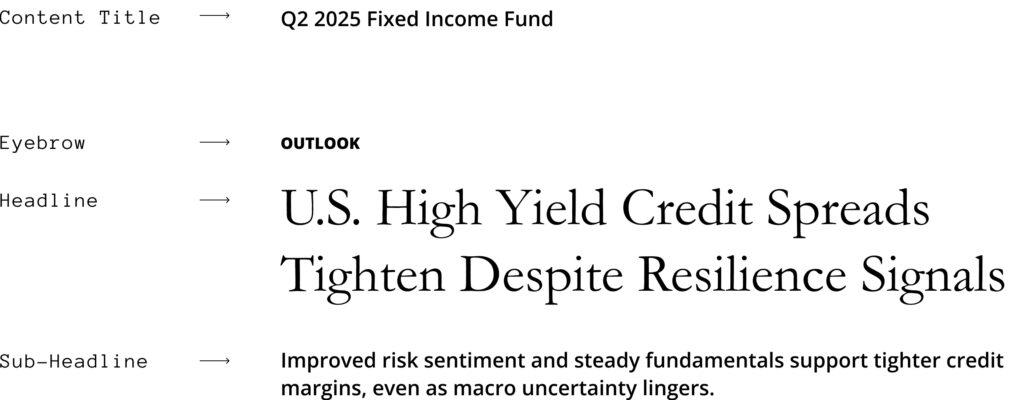
Above, the hierarchy reads as Q2 2025 Fixed Income Fund > Outlook > U.S. High Yield Credit Spreads…
This provides readers a clear understanding of the type of content they’ll encounter on this particular slide without relying on the point of view expressed therein.
Notice the eyebrow, “Outlook”.
It’s doing a lot of the heavy lifting by indicating the slide’s contents. If you’re thumbing through a deck, looking for this firm’s vision of the future in the US Fixed Income sector, you’ll instantly know you’re in the right place without having to digest any further contextual information.
Content Hierarchy helps readers navigate by setting clear topic priorities in a logical order, inviting discovery.
What We Learned:
- Content functions best on a clear foundation of Information Architecture (IA).
- IA is made up of two discrete practices: Content Taxonomy and Content Hierarchy.
- Content Taxonomy is the classification of content.
- Content Hierarchy is the prioritization of content elements.
For assistance in information architecture, copywriting, content strategy, campaign development, or brand storytelling…

Michael Anthony Bradshaw is a creative executive and B2B content strategist based in New York City. He’s led content strategies and creative executions at The Economist, The Wall Street Journal, Edelman, Digitas, and for clients like Goldman Sachs, J.P.Morgan, Novartis, Morgan Stanley, Visa, Accenture—and now advises institutional brands on how to publish with clarity and purpose.